
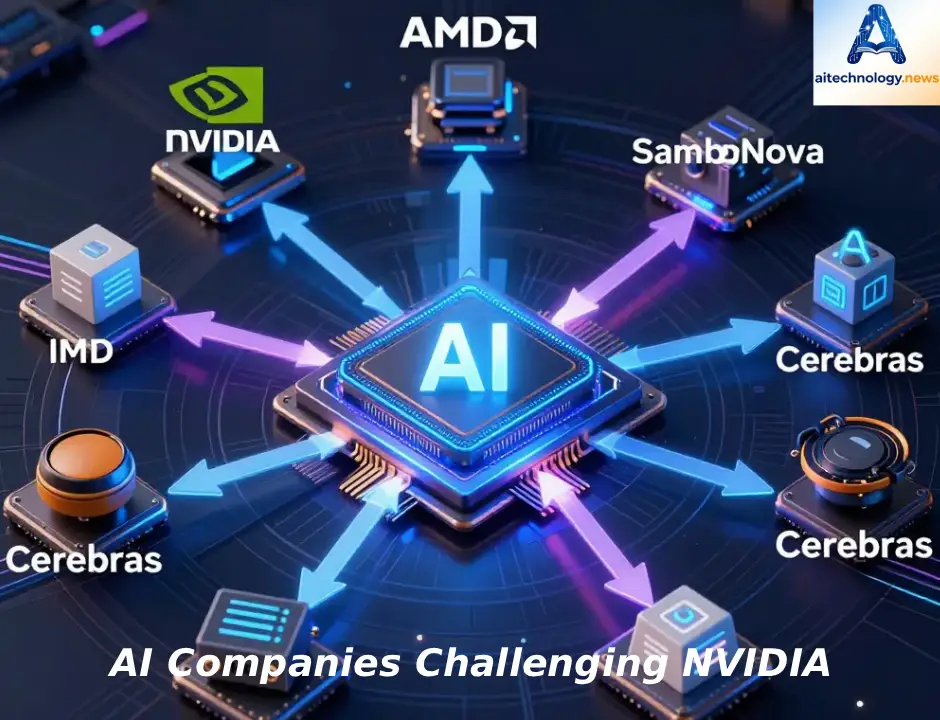
AI Companies Challenging NVIDIA. You’ve probably seen the flashy headlines about who’s supposedly “killing” NVIDIA. But honestly, it’s not a simple story of one company crushing another. The AI chip landscape has gotten pretty messy. New players are pushing boundaries, the big giants are pivoting, and it’s not just a topic for tech nerds anymore. If you’re actually running real-world AI workloads, these shifts seriously impact your speed and your budget.
Let’s be real about why the “NVIDIA vs. Everyone” narrative is so oversimplified: NVIDIA still holds the crown in a lot of areas, mostly because developers are so deeply locked into their CUDA software.
AI Companies Challenging NVIDIA
But actual performance isn’t just about brand loyalty. When you’re running data 24/7, things like power efficiency and total cost of ownership become massive deals. Imagine you’re running a startup—paying for top-tier chips that sit idle half the day is a quick way to burn through your seed funding. A few challengers have started focusing heavily on inference, which is the part where the model actually generates answers, and that’s an area where NVIDIA isn’t always the undisputed champion.
Take SambaNova Systems, for starters. They’re pitching themselves as the fastest AI inference platform around, using clever software that masks the complex hardware underneath to make it easier to run setups. If you’re building a real-time voice assistant, that low latency keeps conversations flowing naturally without draining your edge-device battery. But if you need raw horsepower to challenge NVIDIA’s data center dominance directly, that’s where AMD’s Instinct MI300X comes in.
It boasts massive memory capacity to speed up heavy processing. If you want to run a giant, 70-billion-parameter open-source model locally, AMD’s extra memory lets you fit huge models on fewer chips, saving you a massive headache and tons of budget. If you want something truly wild, look at Cerebras and their Wafer-Scale Engine. Instead of grouping tiny chips together, they built one giant, pizza-sized chip that behaves like thousands of GPUs fused into one.
If you’re a research lab training a model on massive genomic datasets, you know how painful it is when GPUs lag while sync’ing with each other—Cerebras bypasses that bottleneck completely, turning weeks of training into a single afternoon. On the other hand, if you’re not looking to buy physical hardware at all. AI Companies Challenging NVIDIA, Google TPUs and Microsoft Azure Accelerators offer pure cloud convenience.
They plug right into the cloud platforms you’re likely already using, so a small development team can spin up a TPU for a quick weekend of fine-tuning without having to configure physical servers. At the end of the day, all of this matters because of your bottom line. Custom chips can often do more work while pulling less power, translating directly to lower electricity bills and smaller server footprints. If someone like SambaNova or AMD can shave 20% off your inference costs, that’s real money back in your pocket.
Plus, you don’t have to throw out your current tools to make the switch. It’s not about banishing NVIDIA from your workflow forever; it’s about matching your software to the right hardware. If AMD’s setup fits your current tech stack, awesome. If Google TPUs make sense for your cloud stuff, go for it. The goal is to get things running efficiently, not just buying the biggest brand name. Looking ahead, expect the competition to stay specialized.
AI Companies Challenging NVIDIA, SambaNova will likely target edge speed, AMD will go after mainstream data centers, and Cerebras will handle giant training models. With open standards like OpenVINO getting more popular, it’s becoming easier to compare options fairly. The winner won’t be the company with the biggest marketing budget—it’s whoever actually solves your specific bottleneck.