
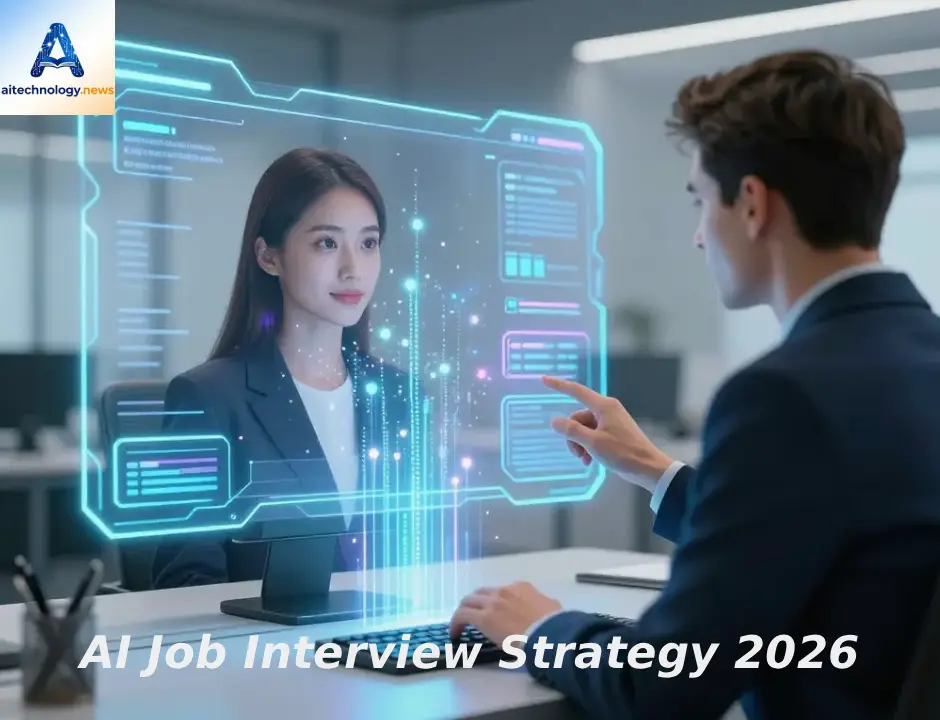
AI Job Interview Strategy: Your 2026 Job Interview Strategy
The “black hole” of online applications is getting deeper. If you’ve ever submitted a resume only to receive a generic rejection email ten seconds later, you’ve felt the sting of the automated gatekeeper.
By 2026, this won’t just be a hurdle for some companies—it will be the standard operating procedure. From Large Language Models (LLMs) scanning for semantic intent to sentiment analysis tools measuring your “culture fit” during video calls, the recruitment landscape has fundamentally shifted.
However, there is a massive opportunity on the other side of this shift. If you understand how these systems work, you can stop fighting the machine and start using it as your most powerful career co-pilot. Here is how to master the AI-driven job market of 2026.
The New Reality: From Keywords to Semantic Clusters
For a decade, “beating the ATS” meant stuffing your resume with keywords. That era is over. Modern AI doesn’t just look for the word “Project Management”; it looks for the context of your experience. It analyzes your career trajectory to see if your past actions align with the company’s future goals.
To succeed, you must move toward Semantic Optimization. This means ensuring that your resume describes not just what you did, but the impact you had using the specific terminology the industry now uses.
Actionable Tip: Use an AI tool to analyze a job description. Ask it to identify the “top five underlying pain points” of the role. Once identified, rewrite your resume bullets to explicitly address those five problems.
Step 1: Intelligence Gathering (The Scout Phase)
Most candidates apply to a job they know nothing about beyond the bullet points. In 2026, that is a losing strategy. You need an Intelligence Dossier.
AI allows you to perform deep-dive research in seconds that used to take hours. You should be looking for:
- Sentiment Analysis: What are customers saying about the company on Reddit or X? Are they frustrated with the UI? Is the customer service lagging?
- Annual Report Mining: For larger corporations, use AI to summarize their latest annual reports. Identify their “Top 3 Strategic Priorities.”
- The “Decision Unit” Map: Use LinkedIn data and AI to identify who actually holds the budget. Is it the VP of Engineering or the Head of Operations? Tailor your language to the person who actually makes the call.
AI Job Interview Strategy 2026. When you walk into the interview, you shouldn’t just be “looking for a job.” You should be presenting yourself as the specific solution to the problems you just discovered in your research.
Step 2: Engineering the “Un-Filterable” Resume
Your resume is a data packet. It is designed to be read by a machine first and a human second. To pass the first gate, your resume must be “machine-readable” in a way that emphasizes high-value results.
Stop using “Responsible for…” Start using “Achieved [X] by doing [Y], resulting in [Z].”
The AI looks for metrics. It wants to see percentages, dollar amounts, and timeframes. If you tell the machine you “improved efficiency,” it ignores you. If you tell the machine you “reduced operational overhead by 22% over six months using automated workflows,” you win.
Step 3: Mastering the Asynchronous Interview
One of the biggest hurdles in 2026 is the asynchronous video interview. These are the “pre-interviews” where you record yourself answering questions prompted on a screen. They are often scored by AI for tone, pacing, and content.
To beat this:
- Scripting for Sentiment: Use an LLM to help draft scripts for common questions. Ensure the scripts include “high-impact” verbs but remain conversational.
- Speech Training: Use AI coaching tools to analyze your recording. Are you using filler words like “um” or “like” too often? Is your tone too flat? The AI is looking for confidence and clarity.
- Environment Optimization: Ensure your lighting and background are professional. A cluttered background can subconsciously (or via AI analysis) signal a lack of organization.
Step 4: The Co-Pilot Strategy (Real-Time Assistance)
This is the most controversial—and most effective—tactic of the 2026 job hunt. During a live Zoom or in-person interview, you are allowed to have a co-pilot. The key is knowing how to use it without looking like you’re reading from a teleprompter.
The Knowledge Base: Have a digital “Cheat Sheet” open on a secondary screen. This shouldn’t be a script; it should be a collection of data points:
- Specific metrics from your past projects.
- The “Pain Points” you discovered in your research.
- The names and roles of the people on the call.
The Bridge Technique: If an interviewer asks a complex question, use a “Bridge” phrase to give your brain time to scan your notes: “That’s a critical point. When I look at how I handled [similar project], one of the key metrics we tracked was…” This allows you to glance at your data while maintaining eye contact and flow.
Step 5: The Human Edge (What AI Can’t Do)
AI Job Interview Strategy 2026: Here is the secret that most people miss: The more AI is used in the hiring process, the more valuable “human” traits become. If a machine can do the analysis, the human must provide the judgment.
In your interview, you must lean into the things AI struggles to simulate:
- Empathy: Show that you understand how your work affects the end-user.
- Nuance: Talk about the times things didn’t go as planned. AI is great at perfect scenarios; humans are hired to solve messy ones.
- Reflection: After describing a success, briefly mention what you learned. This “Reflective Learning” is a high-level cognitive skill that signals leadership potential.
Getting Hired Faster: The 30-60-90 Day Plan
If you want to stand out in a pile of 500 applicants, give them something they didn’t ask for: a 30-60-90 Day Plan.
Use AI to help you structure a document that outlines exactly what you intend to do in your first three months.
- Days 1-30: Integration, learning the internal systems, and building relationships.
- Days 31-60: Identifying “low-hanging fruit” and implementing quick wins.
- Days 61-90: Executing on the primary strategic goals of the department.
Presenting this during the final interview shows that you aren’t just looking for a paycheck—you are already thinking about their success. It shifts the conversation from “Can you do this job?” to “How quickly can we get started?”
Conclusion: Own the Machine
AI Job Interview Strategy 2026. Job market is not about humans vs. machines. It is about humans who use machines to become “super-candidates.” By leveraging AI for research, optimization, and preparation, you remove the friction of the application process and allow your true skills to shine.
Stop viewing AI as a gatekeeper. Start viewing it as your ultimate competitive advantage.
Want to go deeper? Download my full eBook, “AI Job Interview Strategy 2026“ for a step-by-step breakdown of every tool, prompt, and strategy mentioned in this article.