AI Start-up Playbook 2026: How to Build a Profitable AI Tool From $0
The honeymoon phase with AI is officially over. We’re past the days when throwing a basic wrapper on GPT-4 could land you millions in hype and VC funding. Going into 2026, the landscape has shifted. We have moved from the Generative Era—where we were just amazed that AI could write—to the Agentic Era, where we need AI to actually get things done.
For today’s founders, this presents a tricky paradox: building tools has never been easier, but turning a profit has never been harder. The barrier to entry has vanished, while the barrier to generating real revenue has skyrocketed.
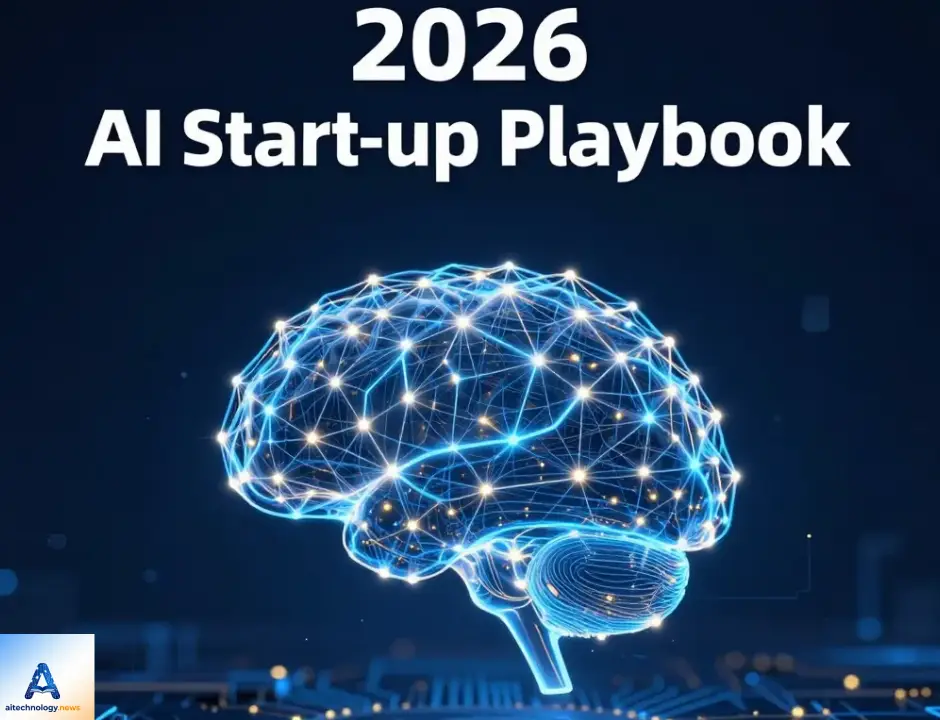
So, how do you build a software company when code is basically a commodity? How do you create real value when everyone has access to the exact same models? The secret isn’t the tech itself; it’s how you orchestrate it. That is the core idea behind our new eBook, “2026 AI Start-up Playbook: How to Build a Profitable AI Tool From $0.”
AI Start-up Playbook – Why Technical Demos Fail (and How to Pivot)
Most AI startups fail because they get stuck in the “Demo Trap.” They spend months building a beautiful prototype that looks great in a pitch deck but doesn’t solve a real, painful problem people will actually pay to fix. They end up building a cool feature instead of a sustainable business.
The playbook breaks down what we call Engineering Validation (EV). Before writing code, you should use the “Wizard of Oz” approach—manually doing the work behind the scenes to prove demand. This zero-cost step lets you fail fast and pivot toward actual product-market fit before you run out of cash. We also dive into the psychology of pivoting—specifically, how to let go of your initial code to follow what the market actually wants.
The Agentic Revolution: Introducing “Agent Opus”
The biggest technological shift right now is the move from standard LLMs (Large Language Models) to LSAs (Large System Agents). Instead of a single chat window where humans prompt a model, we’re transitioning to agentic workflows where AI agents function like independent team members.
A major highlight of the book is the Agent Opus Framework. This isn’t about basic chatbots; it’s about deploying multi-layered systems:
– The Orchestrator (The Director): The brain that breaks large goals down into smaller, manageable tasks.
– The Specialist Agents (The Talent): Cost-effective, highly targeted models built for specific jobs.
– The Evaluator (The Critic): The gatekeeper that checks outputs and prevents “hallucinations.”
Once you master this setup, you stop selling basic tools and start selling concrete outcomes—which completely changes your pricing power.
Surviving a Saturated “Red Ocean”
In 2026, if your pitch is simply “AI for [Generic Task],” you’re already dead in the water. That market is a crowded red ocean of copycat wrappers. To survive, you must find your blue ocean—where smart tech intersects with deep, industry-specific expertise.
AI Start-up Playbook outlines a clear strategy to build a defensible moat around your business, focusing on three key layers:
– The Data Moat: Leveraging proprietary data that massive public models can’t access.
– The Workflow Moat: Integrating so deeply into your customers’ daily tools (like HubSpot) that switching becomes too painful.
– The Trust Moat: Building reliable, verifiable AI systems that prioritize accuracy over flashy, unpredictable generation.
We also explore the power of personal branding. In a world drowning in AI-generated spam, authentic, human-in-the-loop authority is how you stand out. We’ll show you how to build a brand based on real proof of work rather than just screaming into the digital void.
The Real Math: Unit Economics and the “Inference Tax”
AI Start-up Playbook is easily the most critical chapter for any serious founder: the economics of AI. Unlike traditional SaaS, where serving an additional user costs virtually nothing, AI startups pay an “Inference Tax.” Every prompt incurs a direct cost.
Without careful attention to unit economics, rapid growth will only bankrupt you faster. We share simple mathematical frameworks to:
– Manage Inference Margins: Find the sweet spot between expensive reasoning models and cheaper, specialized tools.
– Pricing Strategy: Transition from flat subscriptions to hybrid, usage-based pricing so power users don’t drain your margins.
– The Scalability Paradox: Ensure that as your system scales, your cost-per-task doesn’t spiral out of control.
Your 30-Day Launch Plan
We wrap up the book with a week-by-week execution plan to help bootstrapped founders go from raw idea to validated launch in just 30 days:
– Week 1: Identify customer friction and map the core problem.
– Week 2: Execute Wizard of Oz validation (test market demand with zero code).
– Week 3: Launch a high-converting landing page and capture early leads.
– Week 4: Scope your MVP and finalize the immediate roadmap.
The Bottom Line: The Future Belongs to the Orchestrators
The AI revolution isn’t about who writes the best prompt; it’s about who builds the most stable, integrated, and profitable business. Whether you’re an engineer looking to launch a startup or an established founder defending your turf, this playbook gives you the exact strategic toolkit you need for 2026.
Don’t just build a cool tool. Build a real business.