Category: AI technology

Technology powered by AI

  • Robotics Programming with AI

    Robotics Programming with AI

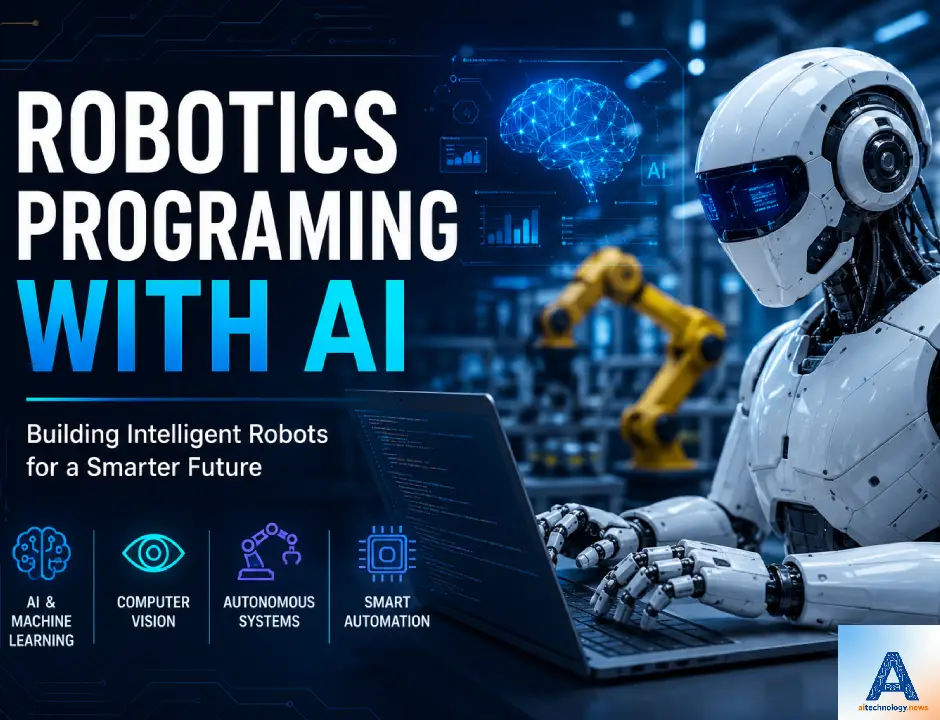
    Robotics Programming with AI: How Intelligent Automation is Changing the Game

    Introduction

    Combining Artificial Intelligence (AI) with robotics unlocks some genuinely incredible possibilities. We are seeing this play out everywhere—from busy warehouse floors and massive factories to modern hospital wings and our own living rooms. Traditional robots were hardwired to repeat the exact same motions based on rigid, pre-programmed instructions. Today’s AI-driven machines, however, are a completely different breed. They can learn, adapt, make split-second decisions, and interact with their surroundings in ways that used to be strictly science fiction.

    AI robotics programming has quickly become one of the fastest-growing spaces in tech. It blends software engineering, machine learning, computer vision, and physical automation to build machines that tackle increasingly complex tasks. As companies push for deeper digital transformation, the demand for intelligent robotics is only going to climb.

    Let’s dive into how AI robotics programming actually works, the core technologies driving it, the go-to languages, and where this field is heading next.

    Robotics Programming with AI

    What Exactly is Robotics Programming with AI?

    Fundamentally, this field is about building machines that don’t just blindly execute loops. Instead, they learn from real-world data, recognize patterns, and make smart, independent choices.

    Take classic industrial robotic arms. They are fantastic at assembling the exact same part in the exact same spot all day long. But if a component is even slightly out of place, the system grinds to a halt until a human steps in to fix it.

    AI-powered robots bring much-needed flexibility to the table. They are capable of:

    * Learning from past trials and experiences
    * Navigating entirely new environments on the fly
    * Identifying specific objects, tools, and people
    * Understanding and responding to natural human speech
    * Predicting outcomes to boost their own performance over time

    By adding this layer of intelligence, developers can build highly adaptable machines capable of handling messy, unpredictable real-world situations with ease.

    The Core Tech Driving AI Robotics

    Machine Learning (ML)
    Instead of relying entirely on hard-coded rules, Machine Learning lets robots learn on the job. This helps them find patterns, make smarter choices, and optimize their daily tasks. For instance, warehouse bots can analyze past trips to figure out the absolute fastest paths to move inventory.

    Deep Learning
    This advanced branch of machine learning uses neural networks modeled after the human brain. It is the secret sauce behind heavy-duty tasks like image recognition, speech processing, and autonomous navigation. Because deep learning can process massive amounts of sensory data, it has become essential for modern robotics.

    Computer Vision
    Computer vision essentially gives robots eyes. By reading data from cameras and sensors, robots can identify objects, track movement, and run quality checks. On a factory line, for example, a vision-equipped robot can spot tiny manufacturing defects much faster and more reliably than any human inspector.

    Natural Language Processing (NLP)
    NLP is what allows robots to understand and talk back to us. We see this in voice-activated smart assistants, interactive customer service bots, and healthcare assistants. It bridges the gap between human language and machine code, making interactions feel way more natural.

    Reinforcement Learning
    Think of this as teaching a robot through trial and error. The system gets a metaphorical “reward” for making a correct decision and a “penalty” for a wrong one. Over time, it learns the absolute best strategy to get the job done. It is widely used to train self-driving cars, navigate tough terrain, and master complex automation tasks.

    The Go-To Programming Languages for AI Robotics

    Python
    Python is the undisputed king of AI development. It is incredibly easy to read and write, has a massive developer community, and comes packed with powerful, ready-to-use libraries like TensorFlow, PyTorch, and OpenCV. If you are working on machine learning or computer vision, Python is almost always your starting point.

    C++
    When you need raw speed and direct control over hardware, C++ is still the gold standard. It executes tasks incredibly fast, processes data in real time, and manages memory efficiently. Many robotics use C++ for safety-critical systems where even a millisecond of lag is unacceptable.

    Java
    Java is known for its stability and cross-platform compatibility. It is often the language of choice for massive, enterprise-level industrial automation setups and large-scale robotic infrastructures.

    ROS (Robot Operating System)
    While not a programming language itself, ROS is a crucial framework that almost everyone in the industry uses. It provides the low-level drivers, communication tools, and software libraries developers need so they do not have to build their robotic systems entirely from scratch.

    How AI Robots Get Built: Step-by-Step

    Step 1: Pinning Down the Goal
    Every project starts with a clear problem to solve, whether that is creating an autonomous delivery cart, automating a messy warehouse, or designing a surgical assistant.

    Step 2: Gathering the Data
    AI is hungry for data. Developers must gather high-quality information from cameras, sensors, GPS trackers, and user inputs to give the AI something to learn from.

    Step 3: Training the AI Model
    Using that gathered data, engineers train machine learning algorithms to perform specific tasks, like recognizing an obstacle or understanding a voice command.

    Step 4: Connecting Software to Hardware
    This is where the magic happens. The trained AI model is integrated with physical components like motors, micro controllers, and cameras so the robot can actually interact with the physical world.

    Step 5: Testing and Tweaking
    Finally, the system goes through rigorous testing to make sure it is safe, fast, and reliable. Developers continuously tweak the algorithms to boost performance over time.

    Real-World Uses for AI Robots

    Manufacturing
    Factories are still the biggest testing grounds for smart robotics. AI bots handle everything from fast-paced assembly lines to predictive maintenance, which alerts teams before a machine breaks down.

    Healthcare
    AI is making waves in medicine. We now have surgical robots assisting with precision operations, rehabilitation bots helping patients recover, and automated delivery systems moving supplies through hospital hallways.

    Logistics and Warehouses
    Giant retailers rely on AI robots to organize inventory, sort packages, and optimize shipping routes, which drastically cuts down on delivery times.

    Smart Farming
    Agriculture is getting a high-tech upgrade. Smart bots can monitor crop health, spot weeds, harvest delicate produce, and analyze soil conditions to help farmers grow more food with fewer resources.

    Self-Driving Vehicles
    Autonomous cars and drones are some of the most advanced AI robots out there. They blend computer vision, sensor fusion, and real-time decision-making to safely navigate busy streets and skies.

    Smart Homes
    On the consumer side, AI is showing up in everyday household gadgets. Devices like smart vacuum cleaners and security bots adapt to your daily routines and navigate around your furniture with ease.

    The Big Benefits of AI Robotics

    *Top-Tier Efficiency:** These robots can run 24/7 without needing coffee breaks, keeping productivity high.
    *Fewer Mistakes:** Machine learning algorithms help eliminate human error, ensuring high precision on repetitive tasks.
    *Lower Costs:** Automating complex processes reduces labor expenses and minimizes material waste.
    *Safer Workplaces:** Handing dangerous jobs in hazardous environments over to robots keeps human workers out of harm’s way.
    *Non-Stop Learning:** Unlike old machines that stay the same forever, AI robots actually get better and smarter the more they work.

    The Challenges We Still Face

    It isn’t all smooth sailing. Developing these advanced systems is incredibly expensive, requiring massive budgets for both high-end hardware and specialized talent. They also need clean, high-quality data to work properly. On top of that, we have to navigate serious ethical issues around job displacement, data privacy, and general safety when these machines operate alongside humans.

    What’s Next? Future Trends to Watch

    *Cobots (Collaborative Robots):** Instead of being locked behind safety cages, these friendly bots are built to work right alongside human coworkers.
    *Edge AI:** By processing data directly on the robot instead of sending it to the cloud, robots can react instantly and keep data more secure.
    *Swarm Robotics:** Imagine a whole flock of simple robots communicating with each other to tackle massive tasks like search-and-rescue missions or complex mapping.
    *Better Human Interaction:** Future bots will be much better at reading our gestures, voice tones, and even facial expressions for a more natural connection.

    Career Outlook

    Thanks to this boom, the job market is wide open. Companies are actively hunting for skilled robotics engineers, machine learning specialists, computer vision pros, and software developers. If you have a foot in both the AI and hardware worlds, you are in a prime position to build a great career.

    Wrapping Up

    AI-driven robotics is easily one of the most exciting fields of our time. By combining cutting-edge software with physical machines, we are building systems that can think, adapt, and solve real problems on their own. While we still have to figure out the high costs and ethical guardrails, there is no denying that smart automation is here to stay. The future isn’t about machines replacing us—it’s about working together to build a smarter, more efficient world.

    #RoboticsProgramming #ArtificialIntelligence #AIRobotics #RobotProgramming #MachineLearning #Automation #ComputerVision #DeepLearning #PythonProgramming #ROS #AutonomousRobots #SmartRobots #IndustrialAutomation #Technology #FutureTech

  • AI Start-up Playbook 2026: How to Build a Profitable AI Tool From $0

    AI Start-up Playbook 2026: How to Build a Profitable AI Tool From $0

    AI Start-up Playbook 2026: How to Build a Profitable AI Tool From $0

    The honeymoon phase with AI is officially over. We’re past the days when throwing a basic wrapper on GPT-4 could land you millions in hype and VC funding. Going into 2026, the landscape has shifted. We have moved from the Generative Era—where we were just amazed that AI could write—to the Agentic Era, where we need AI to actually get things done.

    For today’s founders, this presents a tricky paradox: building tools has never been easier, but turning a profit has never been harder. The barrier to entry has vanished, while the barrier to generating real revenue has skyrocketed.

    So, how do you build a software company when code is basically a commodity? How do you create real value when everyone has access to the exact same models? The secret isn’t the tech itself; it’s how you orchestrate it. That is the core idea behind our new eBook, “2026 AI Start-up Playbook: How to Build a Profitable AI Tool From $0.”

    AI Start-up Playbook – Why Technical Demos Fail (and How to Pivot)

    Most AI startups fail because they get stuck in the “Demo Trap.” They spend months building a beautiful prototype that looks great in a pitch deck but doesn’t solve a real, painful problem people will actually pay to fix. They end up building a cool feature instead of a sustainable business.

    The playbook breaks down what we call Engineering Validation (EV). Before writing code, you should use the “Wizard of Oz” approach—manually doing the work behind the scenes to prove demand. This zero-cost step lets you fail fast and pivot toward actual product-market fit before you run out of cash. We also dive into the psychology of pivoting—specifically, how to let go of your initial code to follow what the market actually wants.

    The Agentic Revolution: Introducing “Agent Opus”

    The biggest technological shift right now is the move from standard LLMs (Large Language Models) to LSAs (Large System Agents). Instead of a single chat window where humans prompt a model, we’re transitioning to agentic workflows where AI agents function like independent team members.

    A major highlight of the book is the Agent Opus Framework. This isn’t about basic chatbots; it’s about deploying multi-layered systems:
    – The Orchestrator (The Director): The brain that breaks large goals down into smaller, manageable tasks.
    – The Specialist Agents (The Talent): Cost-effective, highly targeted models built for specific jobs.
    – The Evaluator (The Critic): The gatekeeper that checks outputs and prevents “hallucinations.”

    Once you master this setup, you stop selling basic tools and start selling concrete outcomes—which completely changes your pricing power.

    Surviving a Saturated “Red Ocean”

    In 2026, if your pitch is simply “AI for [Generic Task],” you’re already dead in the water. That market is a crowded red ocean of copycat wrappers. To survive, you must find your blue ocean—where smart tech intersects with deep, industry-specific expertise.

    AI Start-up Playbook outlines a clear strategy to build a defensible moat around your business, focusing on three key layers:
    – The Data Moat: Leveraging proprietary data that massive public models can’t access.
    – The Workflow Moat: Integrating so deeply into your customers’ daily tools (like HubSpot) that switching becomes too painful.
    – The Trust Moat: Building reliable, verifiable AI systems that prioritize accuracy over flashy, unpredictable generation.

    We also explore the power of personal branding. In a world drowning in AI-generated spam, authentic, human-in-the-loop authority is how you stand out. We’ll show you how to build a brand based on real proof of work rather than just screaming into the digital void.

    The Real Math: Unit Economics and the “Inference Tax”

    AI Start-up Playbook is easily the most critical chapter for any serious founder: the economics of AI. Unlike traditional SaaS, where serving an additional user costs virtually nothing, AI startups pay an “Inference Tax.” Every prompt incurs a direct cost.

    Without careful attention to unit economics, rapid growth will only bankrupt you faster. We share simple mathematical frameworks to:
    – Manage Inference Margins: Find the sweet spot between expensive reasoning models and cheaper, specialized tools.
    – Pricing Strategy: Transition from flat subscriptions to hybrid, usage-based pricing so power users don’t drain your margins.
    – The Scalability Paradox: Ensure that as your system scales, your cost-per-task doesn’t spiral out of control.

    Your 30-Day Launch Plan

    We wrap up the book with a week-by-week execution plan to help bootstrapped founders go from raw idea to validated launch in just 30 days:
    – Week 1: Identify customer friction and map the core problem.
    – Week 2: Execute Wizard of Oz validation (test market demand with zero code).
    – Week 3: Launch a high-converting landing page and capture early leads.
    – Week 4: Scope your MVP and finalize the immediate roadmap.

    The Bottom Line: The Future Belongs to the Orchestrators

    The AI revolution isn’t about who writes the best prompt; it’s about who builds the most stable, integrated, and profitable business. Whether you’re an engineer looking to launch a startup or an established founder defending your turf, this playbook gives you the exact strategic toolkit you need for 2026.

    Don’t just build a cool tool. Build a real business.

  • AI in Computer Science – Transforming the Tech Field

    AI in Computer Science – Transforming the Tech Field

    AI in Computer Science. Artificial intelligence has transitioned from a speculative frontier into the very scaffolding of modern computer science. Far beyond the initial waves of hype, AI is actively reshaping research priorities, ethical standards, global security, and academic curricula. This shift means AI is no longer just a trendy buzzword; it is a foundational pillar of scientific computing and a defining driver of future career paths.

    AI in Computer Science – The Growing Importance of AI in Computer Science

    This evolution from theoretical concepts to practical, everyday tools has transformed fields as diverse as healthcare diagnostics, climate modeling, and cybersecurity. For computer science educators, this rapid integration raises a critical question: how do we adapt our teaching models to prepare students for a landscape where coding and cognitive computing are deeply intertwined?

    Legal Implications for Education

    We are already seeing the legal system step in to address these challenges. Connecticut’s landmark AI legislation, for instance, has sparked a national conversation by requiring school districts to establish proactive policies governing AI in the classroom. As reported by CT Insider, this shift is less about resisting change and more about establishing transparency and accountability. Schools must now evaluate how adaptive learning platforms and automated systems impact students.

    For those studying AI in Computer Science, this regulatory shift sends a clear message: future developers cannot afford to work in a vacuum; they must understand the legal and societal footprints of the software they write.

    This intersection of technology and human responsibility was a central focus at MIT‘s recent Ethics of Computing Research Symposium. Researchers highlighted that despite rapid algorithmic advancements, the human component remains the ultimate anchor for ethical decision-making. As algorithms increasingly influence critical life outcomes, computer scientists are being called upon to design with fairness, data privacy, and bias mitigation in mind. Writing clean code is no longer enough; developers must actively consider its human impact.

    At the same time, the technical boundaries of what AI can do are expanding at an unprecedented rate. For example, researchers at the University of Toronto recently developed an AI-powered computer worm capable of learning and adapting as it moves through networks.

    While this highlights new vectors for cyber threats, it also provides defensive security researchers with critical tools to AI model and neutralize future attacks. Simultaneously, high-performance computing centers, like the FHNW lab, are providing the immense processing power needed to run these complex simulations, enabling researchers to tackle previously impossible calculations—from molecular modeling to energy efficiency optimization.

    Ethical Dimensions: The Human Component in Computing

    Universities are rapidly redesigning their programs to keep pace with these developments. The University of Texas Permian Basin, for example, has introduced a specialized AI in Computer Science track within its computer science department to prepare graduates for roles in machine learning and data engineering. Similarly, Walla Walla University has integrated AI literacy across its curriculum, focusing not just on technical execution, but on teaching students how to critically evaluate AI tools in an automated world.

    The Future of AI in Computer Science

    Ultimately, the future of computer science lies at the intersection of technical skill and ethical stewardship. Success in this field is no longer measured solely by programming proficiency, but by one’s ability to collaborate across disciplines and manage the broader implications of technology. Rather than viewing Computer Science as a replacement for human intellect, the next generation of computer scientists must leverage it as a collaborative tool to solve complex, real-world problems.

    Conclusion:

    Artificial intelligence is fundamentally reshaping the landscape of computer science. Its influence now extends far beyond traditional coding, touching legal frameworks, ethical research, academic curricula, and even automated threat detection. As these technologies evolve, our benchmark for progress must transcend mere processing speed and scale—the true measure of success lies in how effectively AI in Computer Science empowers and elevates human capability.

  • Best AI Models for Blog Article Writing 2026

    Best AI Models for Blog Article Writing 2026

    Best AI Models for Blog Article Writing. While blogging remains a cornerstone of digital marketing, personal branding, and thought leadership, consistently producing high-quality, SEO-optimized content is still incredibly time-consuming. AI writing assistants have stepped in to bridge this gap, allowing teams to draft posts, brainstorm headlines, and optimize keywords in seconds.

    Here is an in-depth breakdown of the leading AI models powering content creation today, focusing on Best AI Models for Blog Article Writing, their real-world strengths, limitations, and ideal use cases to help you choose the right tool for your workflow.

    Best AI Models for Blog Article Writing

    1. OpenAI’s GPT-4o

    **Overview**
    GPT-4o (“omni”) is OpenAI’s flagship multimodal model, designed to process text, audio, and visual inputs natively.

    * **Availability:** Accessible via ChatGPT Plus and the OpenAI API.
    * **Performance Profile:**
    * **Writing Quality:** Delivers highly polished, natural prose with exceptional tone control.
    * **Context Window:** 128k tokens, making it easy to feed in full content briefs, style guides, or reference materials.
    * **Speed:** Up to ten times faster than older GPT models.
    * **Cost:** Included in ChatGPT Plus ($20/month) or via API at $0.03 per 1k input tokens.
    * **Customization:** Supports fine-tuning for highly specific enterprise needs.

    **Best Use Cases**
    * **Long-Form Production:** Ideal for drafting comprehensive guides and analytical pieces quickly.
    * **SEO Optimization:** Integrates keyword clusters naturally without disrupting readability.
    * **Brand Voice Alignment:** Learns your team’s distinct style when provided with previous examples.

    **The Catch**
    * Requires an active internet connection for real-time cloud operations.
    * Fact-checking remains critical, as it can occasionally present inaccurate data with confidence.

    2. Anthropic’s Claude 3.5 Sonnet

    **Overview**
    Claude 3.5 Sonnet is Anthropic’s middle-tier model, renowned for its analytical precision and highly objective, clear writing style.

    * **Availability:** Claude.ai, Anthropic API, and third-party writing tools like Jasper and WriteSonic.
    * **Performance Profile:**
    * **Writing Quality:** Avoids generic corporate fluff, producing straightforward, engaging content.
    * **Safety & Compliance:** Features strict built-in safeguards, minimizing the risk of policy violations.
    * **Speed:** Fast enough for real-time collaborative drafting (~200 tokens/sec).
    * **Cost:** API access is priced around $0.15 per 1k tokens.

    **Best Use Cases**
    * **Technical and Explanatory Writing:** Excellent at translating complex, industry-specific concepts for general audiences.
    * **Regulated Fields:** Perfect for legal, financial, or healthcare blogs where safety and compliance are paramount.

    **The Catch**
    * Slightly higher pricing compared to GPT-4o.
    * Fewer out-of-the-box integrations than OpenAI’s massive ecosystem.

    3. Google Gemini Pro – Best AI Models for Blog Article Writing

    **Overview**
    Gemini 1.5 Pro is Google’s premium multimodal engine, built to handle massive amounts of text, audio, and video data.

    * **Availability:** Google Workspace, Gemini Advanced, and Google Vertex AI.
    * **Performance Profile:**
    * **Writing Quality:** Highly coherent, flowing naturally across multi-paragraph transitions.
    * **Multimodality:** Allows you to upload images directly to generate descriptive text or accurate Alt tags.
    * **Context Window:** Up to 1 million tokens, letting you analyze huge archives of research.
    * **Cost:** Competitively priced API access starting at $0.02 per 1k tokens.

    **Best Use Cases**
    * **Media-Rich Content:** Great for travel or visual blogs that require descriptions and alt text alongside articles.
    * **Workspace Integration:** Works directly inside Google Docs and Sheets, simplifying joint editing workflows.

    **The Catch**
    * Setting up Google Cloud and Vertex API billing can be overly complex for non-technical users.

    4. Meta’s LLaMA 2 (Fine-Tuned)

    **Overview**
    LLaMA 2 is Meta’s open-source large language model, offering a powerful, self-hosted alternative to proprietary software.

    * **Availability:** Self-hosted on private servers or deployed via platforms like Ollama.
    * **Performance Profile:**
    * **Cost:** Zero licensing fees; your only expenses are hosting and hardware.
    * **Control:** Unmatched customization for teams wanting to train a model strictly on proprietary data.
    * **Data Security:** Complete on-premises hosting guarantees your data never leaves your secure network.

    **Best Use Cases**
    * **Enterprise Teams:** Perfect for companies that manage highly confidential data or operate in heavily regulated sectors.
    * **Proprietary Voice Training:** Allows you to build an internal writing assistant trained entirely on your company’s back catalog.

    **The Catch**
    * Requires dedicated GPU hardware and solid DevOps expertise to run smoothly.

    5. Cohere Command R+

    **Overview**
    Command R+ is a enterprise-grade model optimized specifically for Retrieval-Augmented Generation (RAG) and search-grounded workflows.

    * **Availability:** Cohere API and integrations like ChatSonic.
    * **Performance Profile:**
    * **Factuality:** Automatically pulls live information from the web to ground its drafts.
    * **Cost:** Priced at $0.08 per 1k tokens.

    **Best Use Cases**
    * **News & Trending Topics:** Quickly drafts news roundups and opinion pieces based on current real-time data.
    * **Research-Heavy Posts:** Pulls data points directly into your draft, citing sources reliably.

    **The Catch**
    * The search-grounding feature can add minor latency to generation times.

    6. Jasper AI

    **Overview**
    Jasper is an established SaaS platform built specifically for enterprise marketing teams, utilizing underlying engines like GPT-4o and Claude.

    * **Key Features:** Offers pre-built marketing templates, brand voice profiles, and campaign workspaces.
    * **Pricing:** Starts at $49/month.

    **Best Use Cases**
    * **Marketing Campaigns:** Excellent for transforming a single blog post into an array of promotional emails and social copy.

    **The Catch**
    * Can feel rigid if you step outside of their pre-designed marketing frameworks.

    7. WriteSonic

    **Overview**
    WriteSonic is a specialized blogging platform focused on search optimization and direct web publishing. Best AI Models for Blog Article Writing

    * **Key Features:** Features a built-in SEO auditor and a direct integration pipeline to WordPress.
    * **Pricing:** Starts at $29/month.

    **Best Use Cases**
    * **High-Volume SEO Writing:** Great for small businesses looking to quickly scale keyword-focused content.

    **The Catch**
    * Lacks the advanced style customization options found in Jasper.

    8. Sudowrite

    **Overview**
    Sudowrite is an intuitive assistant built for creative writing and storytelling, departing from traditional corporate templates.

    * **Key Features:** Offers deep narrative control, sensory descriptions, and stylistic adjustments.
    * **Pricing:** Starts at $39/month.

    **Best Use Cases**
    * **Narrative & Personal Blogs:** Ideal for travel memoirs, personal essays, or creative storytelling.

    **The Catch**
    * Does not offer native SEO optimization toolkitsfor Best AI Models for Blog Article Writing

    9. Copy.ai

    **Overview**
    Copy.ai is a workflow automation platform geared toward converting core ideas into scalable marketing collateral.

    * **Key Features:** Specialized tools for multi-channel copy generation.
    * **Pricing:** Starts at $35/month.

    **Best Use Cases**
    * **Product & E-commerce Blogs:** Great for drafting high-converting, sales-oriented content.

    **The Catch**
    * Can default to overly repetitive sales language if the prompts aren’t carefully managed.

    10. The Hybrid Strategy: Llama Index + GPT-4o

    For advanced teams, combining a local vector index with a high-performing model like GPT-4o offers the best balance of context, cost, and style precision.

    * **How It Works:** Your internal documentation and archives are indexed locally, and only the most relevant snippets are passed to GPT-4o as prompt context.
    * **Pros:** Keeps API costs incredibly low while virtually eliminating hallucinations.
    * **Cons:** Requires setup development time and regular database maintenance.

    Model Comparison Matrix – Best AI Models for Blog Article Writing

    | Model | Primary Strength | Main Drawback | Best Suited For |
    | :— | :— | :— | :— |
    | **GPT-4o** | Exceptional overall quality | Needs strict fact-checking | Agencies and general writers |
    | **Claude 3.5** | Safe, clean, zero fluff | Slightly higher API cost | Technical and highly regulated niches |
    | **Gemini Pro** | Deep Google workspace ties | Complex backend setup | Media-heavy and collaborative teams |
    | **LLaMA 2** | Ultimate privacy & ownership | Requires developer upkeep | Security-conscious enterprises |
    | **Cohere R+** | Accurate real-time search | Minor processing delay | News and research-driven outlets |
    | **Jasper** | Ready-made team workflows | Premium pricing tier | Active marketing departments |
    | **WriteSonic** | Direct WordPress publishing | Simpler writing engine | Independent site owners and SEOs |
    | **Sudowrite** | Creative style and tone | No built-in SEO tools | Personal essayists and travel writers |
    | **Copy.ai** | Multi-channel alignment | Can sound overly sales-focused | E-commerce brands |

    Best AI Models for Blog Article Writing – Choosing Your Setup

    To pick the ideal tool for your workflow, start by defining your primary bottle-neck: is it keyword research, data integration, or establishing a consistent style? Take advantage of free trials to run identical prompts through two or three platforms, and look for integrations that plug directly into your current CMS or editorial workflow.

    Drafting an Article in Practice: Step-by-Step

    Let’s look at how to draft a balanced, search-optimized post using GPT-4o:

    1. **Prepare the Brief:** List your target keywords, main sections, target word count, and reference articles to establish the right style.
    2. **Guide the Model:** Avoid generic instructions. Provide detailed parameters, specifying structural requirements, keyword integration rules, and formatting preferences.
    3. **Refine the Output:** Read the draft closely. Verify stats, smooth out overly formal or artificial phrases, and ensure the tone reflects your voice.
    4. **Finalize the Post:** Generate appropriate alt text for images, double-check your search metrics, and import the polished text directly into your CMS.

    The Future of AI Content Production

    Over the next few years, expect to see standard integrations move toward real-time keyword updates that adapt instantly to search trends. Additionally, search-grounded models will continuously verify facts as they write, dramatically cutting down the time spent on manual research.

    Ultimately, finding the right platform for Best AI Models for Blog Article Writing is about pairing your unique strategy with the right technological strengths—whether that means relying on GPT-4o for versatile writing, Claude for technical precision, or self-hosted models for complete security.

  • AI-Driven Defense is No Longer Optional in 2026

    AI-Driven Defense is No Longer Optional in 2026

    AI-Driven Defense. The fundamental mathematical paradigm governing cybersecurity has undergone a profound shift. For decades, the industry operated under a symmetric, human-centric dynamic: a cognitive game of cat-and-mouse between human adversaries. Success in this era relied on manual interventions, such as rapidly identifying static signatures, patching vulnerabilities, or blacklisting malicious IP addresses. Given sufficient diligence, defenders maintained an operational advantage rooted in structural scale.

    This symmetry has dissolved with the emergence of automated, machine-scale threats. Contemporary malicious actors utilize autonomous scripts capable of scanning millions of ports concurrently. The threat vector is no longer a static payload but a polymorphic engine capable of mutating its binary structure to bypass conventional heuristics. Consequently, reactive, human-mediated security models are not merely lagging; they are structurally obsolete. Survival now requires transitioning toward automated, self-defending computational systems.

    AI-Driven Defense – The Collapse of Human-Scale Defense

    The contemporary crisis within Security Operations Centers (SOCs) stems not from a deficit of human talent, but from a fundamental mismatch in operational velocity. Three systemic pressures render traditional, human-mediated workflows untenable. The first of these is the unprecedented volume of telemetry. As enterprise architectures transition to cloud-native microservices, the proliferation of API calls, container lifecycles, and service logs creates an overwhelming signal-to-noise ratio. Identifying ‘low-and-slow’ indicators of advanced persistent threats (APTs) within petabytes of unstructured logs is no longer mathematically viable for human analysts.

    Compounding this is the evolution of polymorphic malware. Modern exploits rarely rely on static signatures; instead, they alter their digital footprints during execution. When signature profiles mutate dynamically, traditional boundary defenses such as signature-based firewalls become functionally ineffective. Finally, a profound structural asymmetry exists: while an adversary must automate only a single successful exploit vector, defenders face the mathematically compounding challenge of protecting an exponentially expanding attack surface.

    Transitioning to an AI-driven security posture requires integrating three core technological paradigms: Machine Learning (ML), Deep Learning (DL), and Natural Language Processing (NLP). Together, these systems evolve the modern SOC from a passive repository of log files into an active, predictive ecosystem. Rather than relying on deterministic, AI-Driven Defense, rule-based matching, Machine Learning leverages behavioral heuristics to establish dynamic baselines of user and entity behavior (UEBA). This allows systems to flag subtle behavioral anomalies—such as an account accessing sensitive databases during off-peak hours or an endpoint initiating unauthorized lateral movements—even if no explicit signature matches the activity.

    Deep Learning further abstracts this process by eliminating the need for manual feature engineering. By utilizing multi-layered neural networks, DL systems autonomously extract structural features from binary files, identifying latent malicious patterns in compiled code that remain invisible to human reverse engineers. Lastly, Natural Language Processing bridges the gap between unstructured threat intelligence—such as dark web discourse, security advisories, and bulletin boards—and structured AI-Driven Defense. NLP frameworks ingest these diverse, human-readable texts, converting them into machine-actionable threat intelligence formats, such as STIX/TAXII, in real time.

    This paradigm shift is particularly urgent within cloud environments. The migration from static physical servers to ephemeral microservices and orchestrators like Kubernetes has effectively dissolved the traditional network perimeter. In these highly dynamic environments, where infrastructure exists transiently, manual configurations inevitably suffer from ‘cloud drift’—undocumented discrepancies that introduce severe vulnerabilities.

    Consequently, modern Cloud Security Posture Management (CSPM) must shift from periodic auditing to continuous, autonomous governance. Integrating intelligent algorithms allows CSPM platforms to dynamically map complex attack paths via Graph Neural Networks (GNNs) and enforce zero-trust identity architectures by algorithmically analyzing and revoking unused permissions.

    However, these AI-Driven Defense, technological advancements also introduce significant vulnerabilities, specifically through adversarial machine learning (AML). Threat actors are increasingly employing Generative Adversarial Networks (GANs) to pre-test malware variants against modeled defenses, iteratively refining payloads until they are virtually undetectable before deployment. Additionally, defensive pipelines are vulnerable to data poisoning attacks, wherein adversaries inject corrupted telemetry into training sets to engineer persistent blind spots within the target models.

    The structural battle is no longer fought merely at the level of malicious code, but over the integrity of the underlying mathematical models themselves.

    In conclusion, the integration of artificial intelligence into cybersecurity is not a discretionary enhancement, but a structural imperative. Navigating this transition successfully demands more than the superficial deployment of algorithms; it requires robust data pipelines, a commitment to explainable AI (XAI) models to preserve human oversight, and rigorous lifecycle management of cloud-native systems.

    As AI-Driven Defense, purely human-centric defense models reach their absolute scaling limits, the transition to autonomous, algorithmically driven security architectures becomes inevitable.

  • How to Rank in Google your Blog with AI-2026

    How to Rank in Google your Blog with AI-2026

    How to Rank in Google: This paper explores how artificial intelligence (AI) serves as a strategic asset in modern content marketing and search engine optimization (SEO). By examining current methodologies, theoretical models, and empirical data, we offer practical insights for bloggers looking to improve their search visibility. The study is divided into five key areas: evolving SEO algorithms, strategic AI integration for content, ethics, performance measurement, and future trends. Ultimately, we argue that while AI is incredibly powerful, its success depends on a balanced approach that combines technical skill, data analysis, and continuous learning.

    How to Rank in Google your Blog with AI

    1. Introduction
    The digital publishing world has changed dramatically over the last few years, largely driven by the rapid rise of AI. Google’s search ranking system—which relies on a complex mix of over 200 signals—has grown increasingly sophisticated. It now demands that content creators be highly adaptable, not just high-quality. Traditional SEO techniques like keyword placement and backlink building are still essential, but they are no longer enough to win in a market crowded with automated content.

    This is where AI comes in. By analyzing massive datasets, spotting patterns, and predicting user behavior, AI can help scale and refine content creation. This article How to rank in Google, demonstrates why incorporating AI into your blogging workflow is no longer optional, but vital for maintaining search visibility. We will look at how these tools improve relevance, boost technical performance, streamline planning, and provide clearer performance metrics.

    2. The Evolving Landscape of Algorithmic SEO
    Google’s algorithms are constantly updated to prioritize user intent, natural language processing (NLP), and context over simple keyword matching. Updates like BERT highlight this shift toward semantic understanding. Bloggers no longer need to rely on exact-match keywords; instead, they must focus on topical depth. Additionally,  Google’s emphasis on E-E-A-T (Experience, Expertise, Authoritativeness, and Trustworthiness) underscores the need for genuine value.

    AI supports this shift by helping creators analyze query intent, build comprehensive topic clusters, and avoid low-value, repetitive content. However, How to rank in Google, automation isn’t a silver bullet. Updates like Google’s ‘Helpful Content’ system actively penalize shallow, AI-generated filler. AI should enhance human creativity, not replace it.

    3. Strategic Integration of AI in Blog Content Optimization3.1 Keyword Research and Topic Modeling
    Platforms like Semrush and Clearscope use machine learning to map out keyword clusters and predict user intent using historical trends. For example, instead of targeting ‘machine learning’ broadly, AI can identify fast-growing subtopics like ‘healthcare applications of deep learning,’ aligning content directly with what readers are searching for.

    3.2 Content Generation and Drafting
    While generative tools like GPT-4 or Claude can quickly draft outlines or initial sections, they require heavy human editing. Human authors bring the necessary critical thinking, personal voice, and real-world experience that algorithms crave. This hybrid approach keeps content engaging while satisfying search engines.

    3.3 Personalization and A/B Testing
    AI helps optimize engagement through real-time feedback—like Clearscope’s content gap tools or split-testing platforms—allowing bloggers to continuously improve click-through rates and dwell time.

    4. Technical SEO Enhancements via AI
    4.1 Site Architecture Optimization
    On the technical side, AI simplifies site maintenance. Crawlers like Screaming Frog use NLP to audit site architecture, highlighting broken links, orphaned pages, or duplicate content.

    4.2 Image and Video Optimization
    AI-driven compression tools like TinyPNG speed up load times without sacrificing image quality, while automatic alt-text generation improves web accessibility.

    4.3 Backlink Analysis
    For link building, platforms like Ahrefs analyze semantic relevance to suggest ethical, high-quality backlink opportunities, steering creators away from spammy tactics.

    5. Measurement and Evaluation
    Measuring ROI is much easier with modern tools. Google Analytics 4 uses machine learning to predict user behavior, helping bloggers map traffic growth to specific content changes. How to Rank in Google

    6. Ethical Considerations
    Ethical usage remains critical. Relying on unedited AI text risks search penalties and ruins reader trust. Transparency is key—disclose AI assistance where appropriate, and ensure compliance with data privacy laws.

    7. Conclusion
    Ultimately, AI represents a massive shift in how we approach SEO. When used ethically to support—rather than replace—human insight, it offers an incredible competitive edge. The future belongs to creators who learn to balance automated efficiency with authentic human perspective.

    References

    1. SEMrush (2023). AI-Powered Keyword Research Report. Retrieved from S
    2. Google (2024). Helpful Content Update: Overview. Retrieved from 
    3. Clearscope (n.d.). Content Gap Analysis Tool. Retrieved from